Research
On Maya civilisation — material for a forthcoming novel
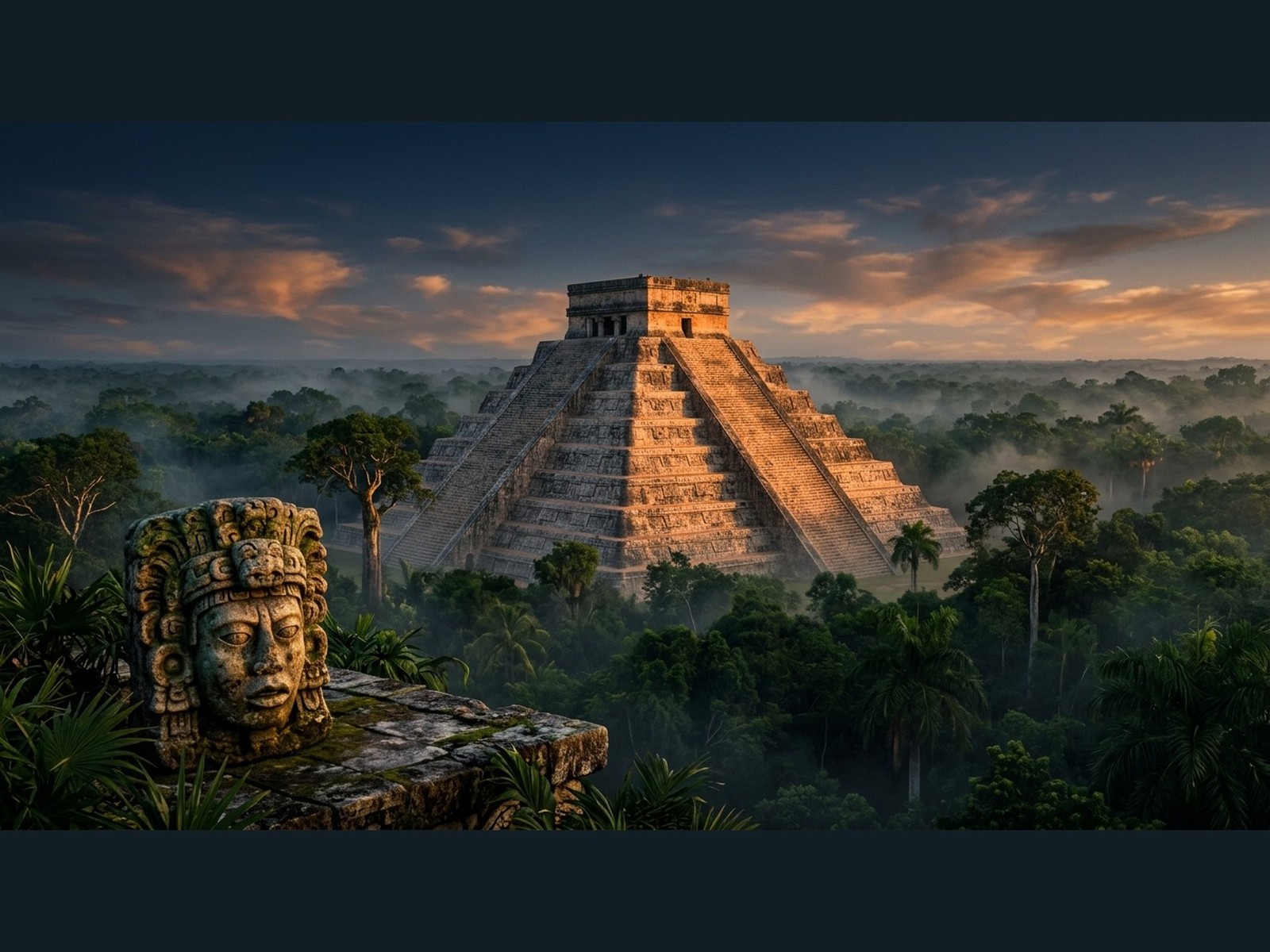
A new novel project is beginning to be written in the silence of books and maps. It will bear on the Maya civilisation, that Mesoamerican culture which unfolded for nearly three thousand years, from southern Mexico to Guatemala, from Belize to western Honduras and El Salvador. A world that never disappeared — but that withdrew, transformed itself, and left behind cities that the tropical forest continues gently to swallow.
── I. One people, a thousand cities ── Contrary to the idea of a single “Maya empire”, Maya civilisation is an archipelago of independent city-states: Tikal, Palenque, Calakmul, Copán, Uxmal, Chichén Itzá, Uaxactún, Yaxchilán, Caracol, Toniná. Each had its dynasty, its alliances, its wars, its rituals and its stelae. What linked them was not a central power, but a common language, a shared writing, an extraordinarily precise calendar and a shared way of naming the world.
── II. A writing that thinks in images ── The Maya are one of the rare pre-Columbian civilisations to have developed a true writing — a logo-syllabic system of over 800 glyphs, mixing sounds and ideas. Long considered undecipherable, it was progressively read from the 1970s onwards through the work of Yuri Knorozov, Linda Schele and David Stuart. It is now known that the stelae are not ornaments: they recount reigns, battles, accessions to power, royal births, with dates as precise as those of a European chronicle.
── III. Time, a Maya obsession ── The Maya measured time with a precision that remains astonishing. Three interlocking calendars: the Tzolk'in (260 days, ritual), the Haab' (365 days, solar), and the Long Count (linear, spanning several millennia). They calculated Venusian cycles, predicted eclipses, anticipated the positions of the planets centuries in advance. Time, for them, was not an arrow but a wheel — and this wheel carried the memory of the gods, of the ancestors and of the world to come.
── IV. A still-mysterious collapse ── Between the eighth and the ninth centuries, the great cities of the south (Tikal, Palenque, Calakmul, Copán) collapse one after another. The populations abandon their ceremonial centres, the inscriptions on stelae cease, the forest regains its rights. What is called the “classic Maya collapse” remains one of the great mysteries of human history. The hypotheses converge: prolonged droughts (documented in lake cores), endemic wars between cities, over-exploitation of soils, political and ritual crises. Not an extinction — but a renunciation, a displacement. The Maya themselves have not disappeared: more than six million Maya descendants live today in Mexico and Central America, speaking thirty different languages.
── V. Why this novel ── To write about the Maya is to write about a civilisation that resisted through memory rather than through force. About a people who encoded their history in stone to make it uprootable. About cities swallowed not by the sea but by the green. About a relationship to time that thinks in cycles rather than in progress. About a writing that refuses the separation between sign and image, between speech and trace.
This novel will not seek to make the Maya an exotic backdrop. It will try to listen to what they had understood — about water, about drought, about the narratives a people builds in order to hold together, and about that fragile moment when even the greatest cities decide, one day, to leave.
── VI. Selective bibliography (research in progress) ── • Michael D. Coe, *The Maya* (Thames & Hudson, 9th edition) • Linda Schele & Peter Mathews, *The Code of Kings* • Nikolai Grube (ed.), *Los Mayas — Arte y Civilización* (Könemann) • Simon Martin & Nikolai Grube, *Chronicle of the Maya Kings and Queens* • Jared Diamond, *Collapse*, chapter on the Maya • Popol Vuh — Adrián Recinos translation (Gallimard, Folio Essais) • David Stuart, *The Order of Days: The Maya World and the Truth about 2012*
The work begins — as always — with maps, cities, languages and silences.