Novels
Les Héritages du vivant: earth, water, air and fire
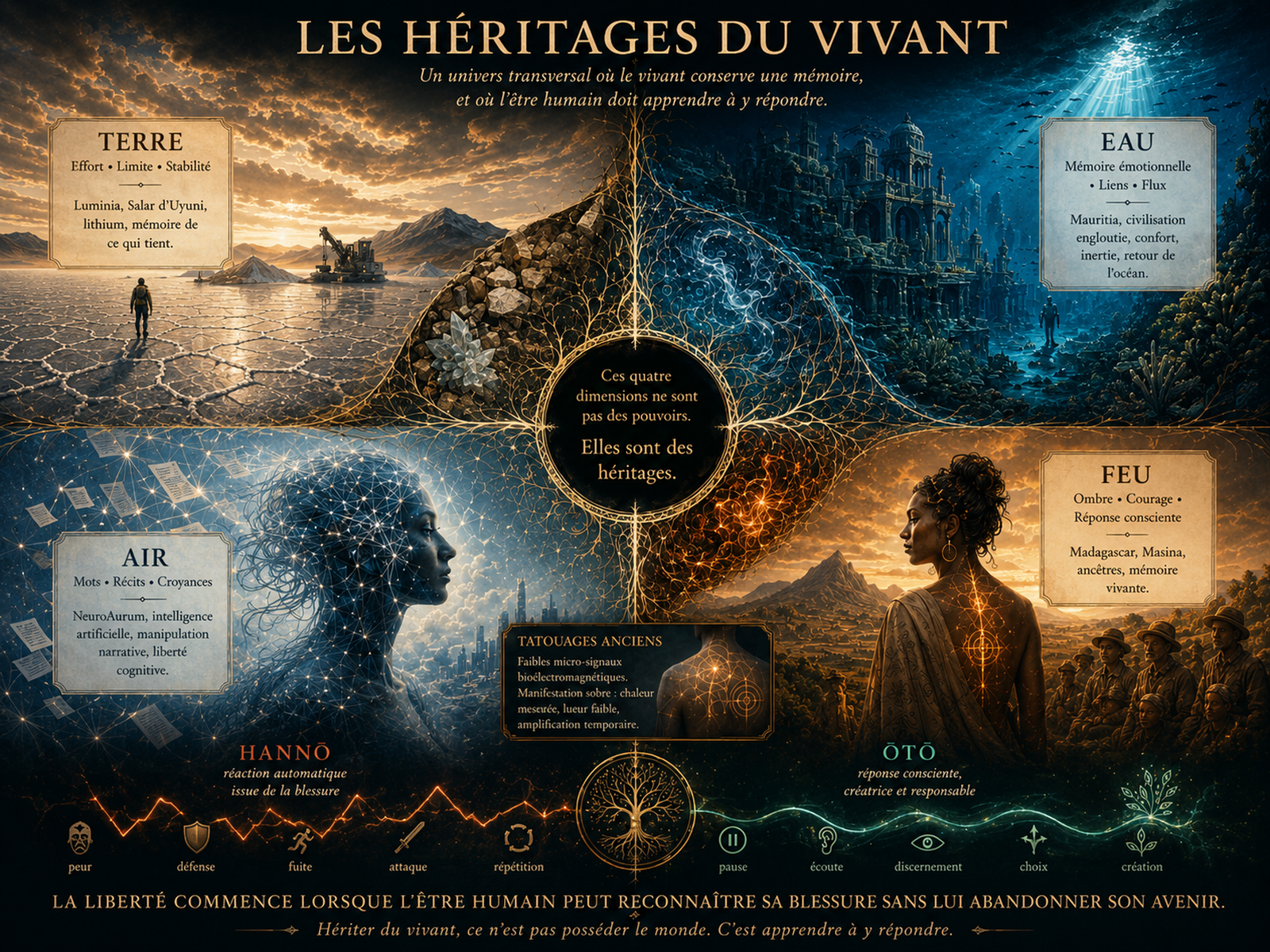
The Legacies of the Living World designates the transversal universe that binds together several novels around a single intuition: the living retains a memory, and this memory compels human beings to transform themselves.
This universe brings together the peoples of the Earth, of the Water, of the Air and of the Fire. Each element corresponds to an inner and civilisational dimension.
The Earth refers to effort, to limit, to stability, to what holds. It is linked to Luminia, to the Salar d'Uyuni, to lithium, to the resources that humanity sometimes extracts without understanding what it is destroying.
The Water refers to emotional memory, to bonds, to flows, to what circulates and to what ends up regaining its rights. It is linked to Mauritia, the vanished civilisation of the Indian Ocean, brilliant but progressively weakened by comfort and inertia.
The Air refers to words, to narratives, to beliefs, to social persona, to what the powerful can manipulate when they understand that governing narratives amounts to governing behaviours. It is linked to NeuroAurum, to artificial intelligence, to narrative manipulation and to cognitive freedom.
The Fire refers to shadow, to anger, to courage, to conscious response. It is not a destructive or magical fire, but an inner energy capable of transforming the wound into a free decision. It is linked to Madagascar, to Masina, to the ancestors and to living memory.
These four dimensions are not powers. They are legacies. They do not give the characters a spectacular superiority. On the contrary, they confront them with their responsibilities, their wounds, their choices.
In this universe, the ancient tattoos play a particular role. They do not read thoughts. They produce no miracle. They emit weak bioelectromagnetic micro-signals, activated by the proximity of other compatible variants. Their manifestation remains sober: measured warmth, faint glow, temporary amplification.
This choice is important. It allows the marvellous to be inscribed within a biological and symbolic logic, without leaving the real entirely.
The Legacies of the Living World also rest on an essential distinction: Hannō and Ōtō. Hannō designates the automatic reaction born from the wound. Ōtō designates the conscious, creative and responsible response.
This distinction runs through the characters and the civilisations. A wounded person can develop expectations of danger, rejection or powerlessness. But it is never a question of making the victim responsible for what they suffer. It is a question of showing that a transformation becomes possible when a human being recognises what the wound has produced, then refuses to abandon their future to it.
Violence was a response when speech had no longer found a way. Passivity was a response when action had ceased to seem possible. But neither of the two was a freedom.
Freedom begins when a human being can recognise their wound without abandoning their future to it.
The Legacies of the Living World is therefore a novelistic universe, but also a reflection on our times. We have powerful technologies, immense knowledge, considerable means of action. And yet, we often remain prisoners of narratives of domination, extraction, fear, comfort or flight.
The peoples of the living do not come to save humanity in its place. They only remind it of one thing: to inherit the living is not to possess the world. It is to learn to respond to it.